P2 Electrostatics Qualitative Lab
The purpose of this activity is to gain knowledge and experience with: positive and negative charges, charging by processes of conduction and induction, and the material types of conductors and insulators.
Electric Field Detector
The electric field detector reveals the presence of positive or negative charge by detection of the relative strength of the electric field produced by charged objects. Attach the green terminal to an appropriate ground, turn the device on, and then simply bring the object in question near the electrode that protrudes from the device. Do not touch the object to the device (this can transfer charge to the electrode, which is not desirable). When there is nothing near the electrode the reading should be zero and no LED’s should be lit – if this is not the case then press the reset button. For this experiment, start with “high” sensitivity, which is best for detecting relatively weak electric fields. (the “low” setting is useful for stronger fields – probably not needed)
NOTE: to make a “fair comparison” of charge amounts place each object at the same distance and note the number of blue or red LED’s that light up. This gives you a somewhat quantitative way to compare charge quantities.
Part A – Triboelectric Effect
Materials sometimes become charged due to the effect of contact and/or friction. This is the triboelectric effect. Use the electric field detector to determine and rank the triboelectric tendencies of the six materials/items used in the following four interactions:
1. CPVC pipe (tan) rubbed with fur
2. acrylic pipe (clear) rubbed with felt
3. glass rod rubbed with silk
also: feel free to try other combinations such as acrylic pipe and silk, fur and glass, etc.
In the ranking, show the “tendencies” of the materials/items – from the material/item with the greatest tendency to become most negative to that with the greatest tendency to become most positive. Any materials/items that show little tendency to gain either type of charge are “in the middle” of this list – near “zero” on a “tendency number line”.
Part B – Conductors, Conduction, and Induction
The
following experiments incorporate an electroscope. The “needle” of the
electroscope will deflect from vertical in the presence of charge. The amount
of deflection can be used to judge the relative amount of charge. If the
electroscope’s aluminum parts gain a net charge, then it may be necessary to
“reset” by touching it with your hand or a grounding wire in order to return it
to neutral.
1.
Use the
electric field detector to confirm that the various aluminum parts of the
electroscope are initially neutral. Charge the CPVC pipe and bring it near,
but do not touch, the small metal sphere (“charge sampler”) atop the
electroscope. Observe the effect on the pivoting needle. After the charged
pipe is then removed from the vicinity, use the electric field detector to
observe the charge (or absence thereof) on the various aluminum parts of the
electroscope. Repeat the experiment with a positively charged rod.
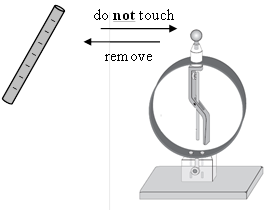
2.
Repeat the
experiments described above, but this time allow the charged pipe to actually
touch the charge sampler. You can “reset” the electroscope to neutral by
touching it with your finger or a grounding wire. Do this experiment with both
negative and positive charged rods. As before use the field detector to
observe the charge on the various parts of the electroscope before and after
the process.
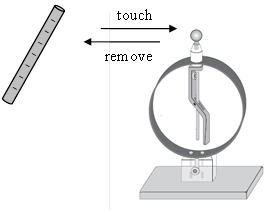
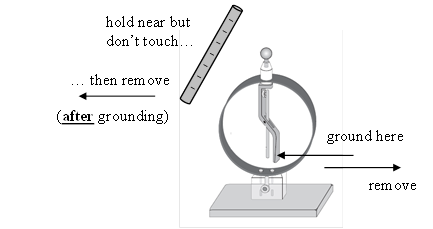
3.
Discharge the electroscope.
Use the charged CPVC pipe, but, as in experiment 1 above, do not allow
it to touch or spark at any point. Bring the charged pipe about 1 or 2 cm away
from the charge sampler and hold it in place without touching (or sparking).
Then ground the bottom of the stationary aluminum support by briefly touching
it with your finger or a grounding wire in the location shown. Then remove the
charged pipe from the vicinity of the electroscope. After the charged pipe is
removed from the vicinity, use the electric field detector to observe the
charge on the various aluminum parts of the electroscope. Repeat the
experiment with a positively charged rod.
Data/Observations (responses may be on separate paper if desired)
Part A
Triboelectric Tendencies (ordered list of six items/materials)
 most
negative most
positive
most
negative most
positive
Part B
Questions for each of the three experiments performed in part B. In your responses to each question below you should refer to observations made with the field detector and also describe how electrons have been affected by the actions taken.
1.
(a) Why does
the needle move when the negatively charged pipe is near but not touching the
charge sampler? Why does it do the same thing with the positively charged
pipe?
(b) Why does the needle return to vertical once the charged pipe is removed?
2.
(a) What is the
evidence that conduction has occurred? What is the evidence that aluminum is a
conductor?
(b) Why does the needle “stay stuck in place” after the charged pipe is
removed?
3.
(a) Is the net
charge on the electroscope after the procedure the same or opposite of
the charged rod used during the procedure?
(b) Explain why and how the electroscope obtains a net charge without being
touched by the charged rod.